
The Ultimate Guide to Whole-House Filtration Systems (The Antidote)
Whole-House Water Filters at a Glance
What they are
Point-of-entry filtration systems installed on the main water line to treat all water entering the home.
Why they matter
They protect plumbing appliances skin and hair while improving overall water quality throughout the house.
What they treat
Commonly reduce chlorine chloramines sediment VOCs and some heavy metals depending on media type.
Identification: The Whole-House Filtration Encyclopedia
A Whole-House Water Filtration System, also known as a Point-of-Entry (POE) system, is the comprehensive “antidote” designed to treat every drop of water that enters your home. Unlike under-sink filters that only protect a single faucet, a whole-house system is installed at the main water line, ensuring that the water used for showering, laundry, dishwashing, and drinking is consistently purified. In 2026, these systems have moved from being a luxury to a critical infrastructure upgrade for homeowners concerned about aging municipal pipes, chemical disinfectants, and environmental pollutants.
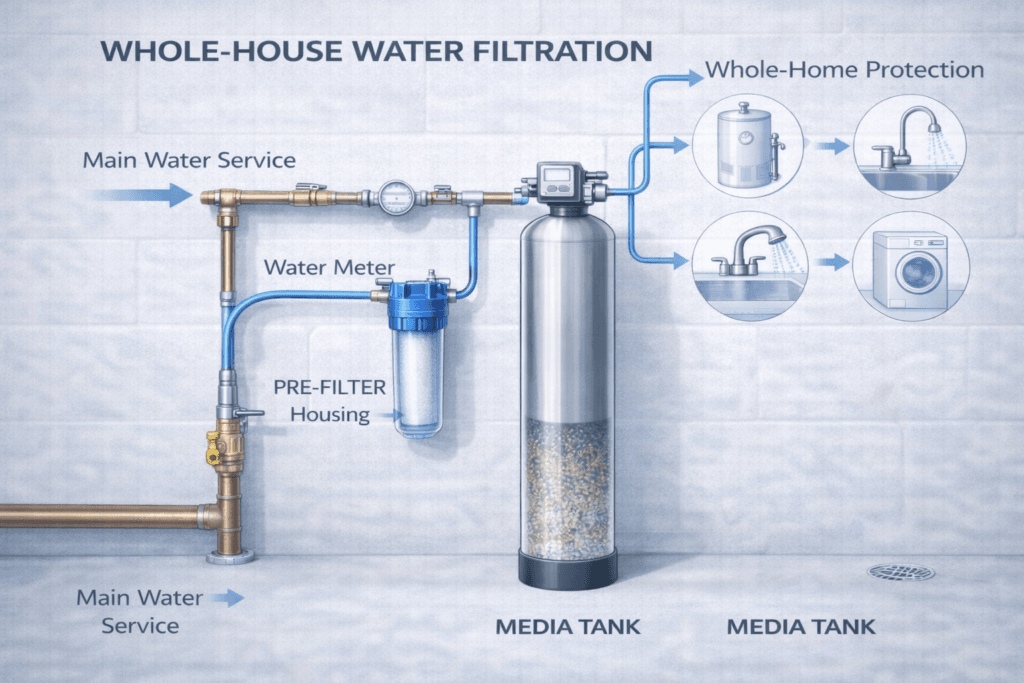
POE vs. POU: Understanding the Scope of Protection
The fundamental difference between filtration strategies lies in their scope.
- Point-of-Use (POU): These are localized “antidotes” like under-sink RO systems or showerhead filters. They provide high-intensity purification for specific tasks but leave the rest of your home’s plumbing vulnerable to contaminants.
- Point-of-Entry (POE): A whole-house system acts as a “gatekeeper”. By treating water at the source, it prevents chemicals like chlorine from vaporizing in the shower (improving indoor air quality) and stops sediment from clogging your water heater and appliances.
Why Choose a Whole-House System in 2026?
Modern water challenges have evolved beyond basic taste and odor issues. Today’s “Solution Hub” approach addresses three primary categories of concern:
1. Infrastructure Protection Aging city infrastructure and private well casings can release rust, silt, and microplastics into your supply. A whole-house sediment filter acts as the first line of defense, physically blocking these particles from entering your home’s “veins” your pipes and high-end appliances.
2. Chemical Neutralization Municipalities rely on chlorine or chloramines to keep water biologically safe during transit. However, once that water reaches your home, these chemicals are no longer needed and can cause dry skin, brittle hair, and a “swimming pool” taste. A POE system neutralizes these chemicals before they touch your body or your clothes.
3. Environmental Resilience In 2026, environmental events such as wildfires or industrial runoff can cause sudden spikes in Volatile Organic Compounds (VOCs) and PFAS (“forever chemicals”). A robust whole-house carbon system provides a constant safety net, ensuring your household remains protected even when local water conditions fluctuate.
Signs Your Home Needs a Whole-House Antidote
While a water test is the ultimate diagnostic tool, your home often exhibits symptoms that point toward a need for whole-house treatment:
- Chlorine Smell: A strong chemical odor in the shower or when running the laundry.
- Staining: Persistent orange or brown stains on toilets and tubs (indicating iron or sediment).
- Appliance Failure: Frequent repairs needed for your dishwasher, water heater, or washing machine due to grit and debris.
- Skin Sensitivity: Increased dryness or irritation after bathing, particularly for family members with sensitive skin.
By identifying these broad-spectrum issues, you can choose a POE system that serves as the foundation for your entire home’s water quality.
Analysis: The Science of Multi-Media Filtration
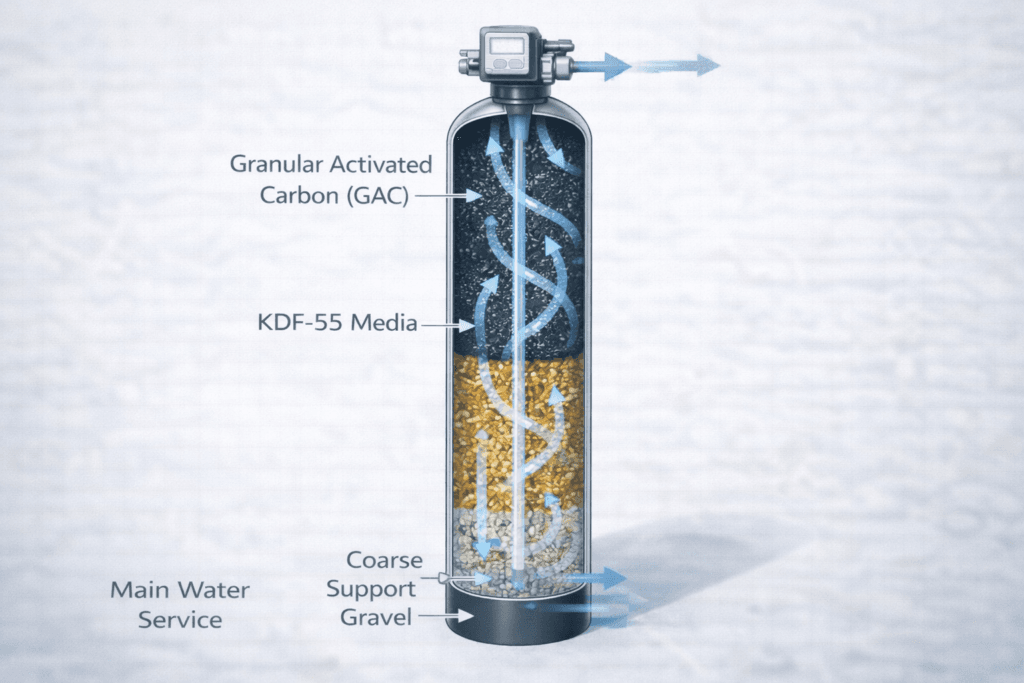
To understand why a whole-house system is the ultimate “antidote” for your home, you must look inside the tank. Unlike simple pleated filters, professional-grade Point-of-Entry (POE) systems utilize Multi-Media Filtration. This process involves layering different specialized materials—each with a unique chemical or physical property—to create a comprehensive treatment “bed.” In the 2026 landscape, the effectiveness of a system is measured by its ability to maintain high flow rates while providing maximum “contact time” with these media.
The Power of Adsorption: Activated Carbon
The most critical component in any whole-house system is Activated Carbon. This media is prized for its incredible surface area; a single pound of activated carbon can have a surface area equivalent to 100 acres. Through a process called adsorption, carbon acts like a chemical magnet, pulling contaminants out of the water and locking them into its microscopic pores.
Granular Activated Carbon (GAC) GAC is the industry standard for removing chlorine, herbicides, pesticides, and Volatile Organic Compounds (VOCs). By removing these chemicals at the entry point, the system ensures that the water used in your dishwasher doesn’t release chlorine gas into your kitchen and that your skin doesn’t absorb synthetic chemicals while you soak in the tub.
Catalytic Carbon As many municipalities transition from chlorine to chloramines (a more stable but harder-to-remove disinfectant), standard GAC is often insufficient. Catalytic carbon is a specially processed version of GAC designed to break the bond between chlorine and ammonia. In the 2026 “Solution Hub” strategy, catalytic carbon is essential for urban homeowners who want to eliminate the persistent “medicine” taste associated with chloraminated water.
Redox Reactions: KDF-55 and KDF-85
Advanced whole-house systems often incorporate KDF (Kinetic Degradation Fluxion), a high-purity copper-zinc alloy. KDF doesn’t just trap contaminants; it uses a process called redox (oxidation-reduction) to change the molecular structure of pollutants, making them harmless.
- KDF-55: Specifically targets chlorine and water-soluble heavy metals like lead, mercury, and chromium. It also has a bacteriostatic effect, meaning it prevents the growth of bacteria and algae within the filter bed, extending the life of the carbon.
- KDF-85: Optimized for well water users, this media focuses on the removal of hydrogen sulfide (the “rotten egg” smell) and dissolved iron. By neutralizing these at the main line, you protect your luxury brass fixtures from the pitting and discoloration caused by metallic oxidation.
The Physics of Contact Time and Flow
A scientific reality of whole-house filtration is the relationship between Empty Bed Contact Time (EBCT) and water quality. For the “antidote” to work, the water must spend enough time touching the media for the chemical reactions to occur. This is why professional POE systems use large, vertical tanks rather than small cartridges.
In 2026, high-efficiency systems utilize “Upflow” technology. Instead of water being pushed down through the media (which can cause “channeling” where water finds a path of least resistance), the water is forced upward through the bed. This lifts and swirls the media, ensuring every drop of water makes contact with the filtration surface. This design also prevents the media from packing down, maintaining a high flow rate that supports multiple showers and appliances running simultaneously without a drop in pressure.
Specialized Media for Targeted Solutions
Beyond carbon and KDF, a truly customized treatment chain may include:
- Activated Alumina: Used specifically in regions with high fluoride or arsenic levels.
- Zeolite: A volcanic mineral used for its high ion-exchange capacity, often used to clarify water and remove traces of ammonium.
- Sediment Sand/Anthracite: Used in the bottom layers to provide final physical straining, ensuring no media particles escape into your home’s plumbing.
By layering these sciences, a whole-house system provides a depth of filtration that simple filters cannot match, transforming the chemical profile of your water before it reaches a single tap.
The Solution: Choosing Your System
Selecting the correct “antidote” for your entire home requires a choice between two primary delivery methods: Tank-Based Systems and Cartridge-Based Systems. In the 2026 water treatment market, this decision is usually driven by your household’s water volume requirements, the specific contaminants identified in your city data, and your preference for long-term maintenance.
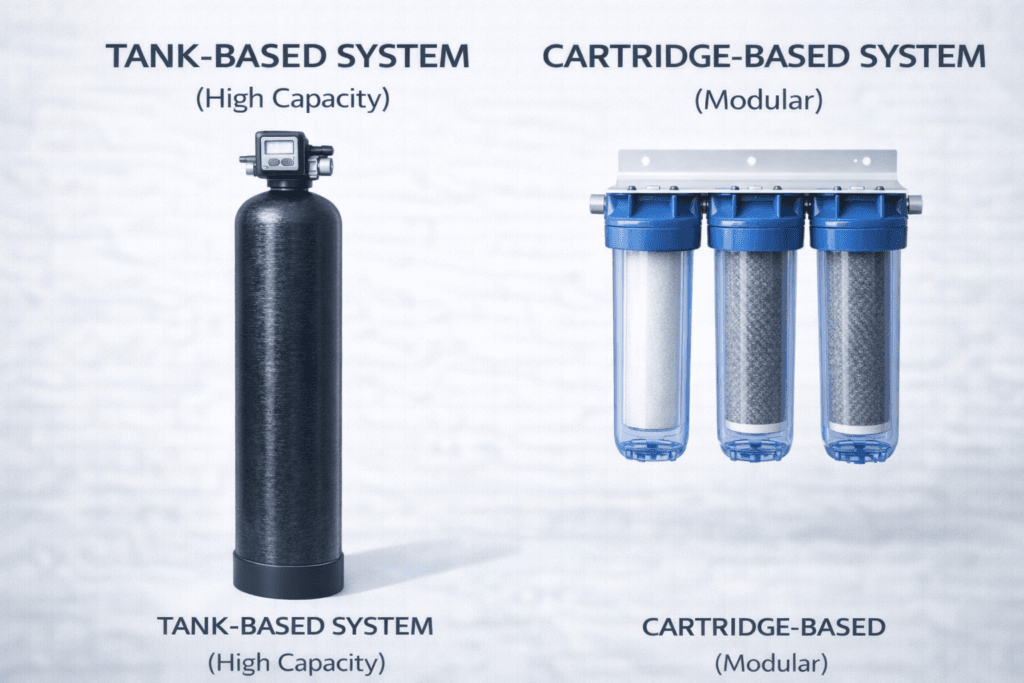
Tank-Based Systems (The High-Capacity Solution)
Tank-based systems are the professional standard for comprehensive, whole-house treatment. These large, vertical cylinders are designed to hold a significant volume of filtration media (such as Carbon or KDF), providing the maximum contact time necessary to neutralize complex chemicals like chloramines and VOCs.
Why Choose a Tank System?
- Longevity: A high-quality tank system can last 5 to 10 years before the internal media needs to be replaced. This makes it a “set it and forget it” solution for busy households.
- Flow Rates: Because of their size, they can support high-flow demands—allowing multiple showers, a dishwasher, and a washing machine to run simultaneously without a drop in water pressure.
- No Pressure Drop: Advanced 2026 models utilize Upflow Technology, which prevents the media from packing down and ensures consistent pressure throughout the home’s lifespan.
Key Considerations:
They represent a higher initial investment and require more floor space near your main water shut-off valve. However, the cost per gallon treated is significantly lower over the life of the system.
Cartridge-Based Systems (The Targeted Solution)
Cartridge-based systems consist of one or more heavy-duty housings that hold replaceable filter “cores.” These are ideal for homeowners who need a more modular or budget-friendly entry into whole-house filtration.
Why Choose a Cartridge System?
- Customization: You can “stack” different filters based on your specific needs (e.g., a sediment filter in Stage 1 and a carbon block in Stage 2).
- Compact Design: These systems take up very little space and are often mounted directly to a wall.
- Affordability: The upfront cost is lower, making it an accessible antidote for those focusing on specific issues like visible sediment or basic chlorine removal.
Key Considerations:
Cartridges have a limited lifespan—usually 3 to 6 months—and must be physically replaced. If you have very high water usage or heavy contaminant loading, the cost and labor of frequent filter changes can quickly surpass the price of a tank-based system.
Technical Comparison Table (2026 Standards)
| Feature | Tank-Based System | Cartridge-Based System |
| Media Lifespan | 5 – 10 Years | 3 – 12 Months |
| Maintenance | Minimal (Media replacement) | High (Frequent filter swaps) |
| Target Contaminants | Chemicals, VOCs, Heavy Metals | Sediment, Chlorine, Lead |
| Initial Cost | Moderate to High | Low to Moderate |
| Long-term Cost | Lowest per gallon | Moderate to High |
| Ideal For | Large families / Heavy usage | Small homes / Targeted filtration |
The 2026 Sizing Formula
In the professional water treatment industry, this is known as the “Money Section” because incorrect sizing is the single most expensive mistake a homeowner can make. If you undersize a whole-house system, you will experience a frustrating drop in water pressure every time a second faucet is opened; if you oversize it, you waste thousands of dollars on unneeded media and excess backwash water. For 2026, sizing has evolved beyond “square footage” and is now calculated based on Peak Flow Rate (GPM) and Media Velocity.
Step 1: Calculating Your Peak Flow Demand (GPM)
The “Antidote” must be able to treat water at the speed your household consumes it. Unlike an under-sink filter which has a dedicated tap, a whole-house system must handle the “Peak Demand”—the moment when your family is using the most water simultaneously.
To calculate your GPM demand, add the flow rates of the appliances you likely use at the same time:
- Modern Showerhead: 2.0 – 2.5 GPM
- Kitchen Faucet: 2.2 GPM
- Toilet Flush: 1.6 GPM (intermittent)
- Dishwasher/Washing Machine: 2.0 – 4.0 GPM
The 2026 Household Standard:
For a standard 3-bedroom, 2-bathroom home, a peak demand of 12 to 15 GPM is the target. If you have luxury features like a rainfall showerhead (often 5+ GPM) or a high-capacity soaking tub, your requirement can easily jump to 20+ GPM.
Step 2: Matching Tank Diameter to Plumbing Size
The physical size of the filter tank—specifically its diameter—determines the maximum flow rate the system can handle without causing a pressure drop. In 2026, we also factor in your home’s main pipe diameter.
- 3/4-Inch Plumbing: Common in older homes. A 10″ x 54″ tank is usually sufficient, supporting up to 10 GPM.
- 1-Inch Plumbing: Standard for modern construction. Requires a 12″ x 52″ or 13″ x 54″ tank to maintain a 12–15 GPM service flow.
- 1.25-Inch+ Plumbing: Found in large custom homes. Requires 14″ or 16″ tanks to avoid becoming a “bottleneck” in your water supply.
Step 3: Media Volume and Service Flow Rate
The amount of media (Carbon, KDF, etc.) inside the tank is measured in Cubic Feet. For the “Antidote” to be effective, the water must stay in contact with the media for a specific duration, known as “Contact Time”.
- 1.5 Cubic Feet: Supports a continuous flow of 8–10 GPM.
- 2.0 Cubic Feet: Supports a continuous flow of 12–14 GPM.
- 3.0+ Cubic Feet: Necessary for heavy chemical removal or large households.
Step 4: The 2026 Sizing Matrix
Use this matrix to identify the baseline technical requirements for your PurityMap solution based on your household size and plumbing configuration.
| Household Profile | Peak Demand (GPM) | Plumbing Size | Recommended Tank Size | Media Volume |
| 1-2 People / 1 Bath | 7 – 9 GPM | 3/4″ | 9″ x 48″ | 1.0 Cu. Ft. |
| 3-4 People / 2 Baths | 12 – 15 GPM | 1″ | 10″ x 54″ | 1.5 Cu. Ft. |
| 5-6 People / 3 Baths | 15 – 20 GPM | 1″ | 12″ x 52″ | 2.0 Cu. Ft. |
| Large Estate / 4+ Baths | 25+ GPM | 1.25″ – 1.5″ | 14″ x 65″ (Twin) | 3.0+ Cu. Ft. |
By sizing for the Peak Flow Rate rather than just “average daily use,” you ensure that your whole-house system remains a silent protector that never interferes with your home’s luxury or convenience.
Integration: Building Your Treatment Chain
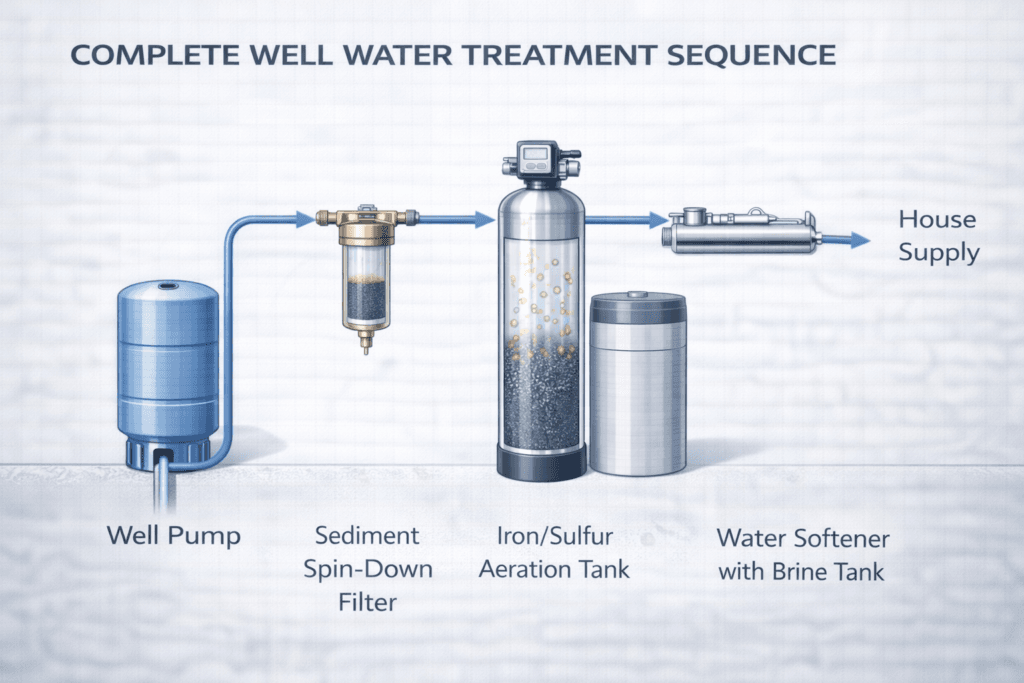
In the PurityMap “Solution Hub” philosophy, a whole-house filter is rarely a standalone device; it is the tactical foundation of a larger treatment sequence. True water mastery in 2026 requires an “Integration Chain” a series of components arranged in a specific logical order to ensure that each stage protects the next and that the final output meets both utility and consumption standards. The way you sequence these components depends entirely on your water source, as the “antidote” for municipal chemicals is fundamentally different from the one for well water contaminants.
The Professional Sequence for Municipal Water
For city water users, the primary goal is the removal of disinfectants like chlorine or chloramines and the protection against aging infrastructure. The integration chain follows this standard professional flow:
- Sediment Pre-Filter: The “Gatekeeper” that stops rust and silt from city pipes.
- Whole-House Carbon/KDF Tank: The “Neutralizer” that adsorbs chlorine and heavy metals.
- Water Softener (Optional): If your city data shows hardness, the softener follows the carbon stage to prevent scale.
- Under-Sink RO/UF: The “Final Polish” for drinking and cooking water.
In this municipal sequence, placing the carbon tank before the softener is critical. Chlorine is a powerful oxidizer that can physically degrade water softener resin, causing it to become mushy and lose its capacity. By neutralizing chlorine first, you extend the life of your softener by years.
The Professional Sequence for Well Water
Well water integration is more complex because it must account for biological risks and varying mineral loads that municipal plants typically handle. The “Antidote Chain” for a private well typically follows this logic:
- Pressure Tank: Establishes the flow and pressure for the rest of the chain.
- Backwashable Sediment Filter: Handles the heavier sand and silt common in groundwater.
- Iron/Sulfur Filter: Removes the “rotten egg” smell and metallic staining before they reach the softener.
- Water Softener: Addresses the naturally high mineral content found in many aquifers.
- UV Sterilizer: The “Biological Shield” that serves as the final whole-house stage.
On a well system, the UV Sterilizer must be the last component in the whole-house chain. For UV light to effectively scramble the DNA of bacteria and viruses, the water must be perfectly clear (low turbidity) and soft. If placed earlier, mineral scale can coat the UV lamp’s quartz sleeve, blocking the light and rendering the “antidote” useless.
Creating the “Antidote Loop”
Integration also means connecting your Whole-House (POE) system with your Under-Sink (POU) system. In a fully integrated 2026 home, the POE system handles the “macro-filtration”—removing 99% of the chlorine and sediment so that every shower and laundry load is clean. This creates a “clean slate” for your under-sink Reverse Osmosis system, which can then focus its 0.0001-micron membrane on the “micro-purification” of lead, fluoride, and pharmaceutical residues.
This integrated loop is what transforms a house into a PurityMap “Solution Hub,” providing tiered protection that is more reliable and cost-effective than any single-filter approach could ever be.
Maintenance & Troubleshooting
A whole-house filtration system is the “heavy armor” of your home’s water defense, but even armor requires cleaning and repair to remain functional. Because a Point-of-Entry (POE) system processes every gallon of water you use, it is subject to intense physical and chemical wear. Neglecting the maintenance of your “antidote” doesn’t just reduce its efficiency; it can lead to severe pressure drops and the re-introduction of contaminants into your entire plumbing network.
The 2026 Professional Maintenance Protocol
To ensure your system provides a continuous, high-flow shield for 10–15 years, follow this tiered schedule adapted for 2026 high-efficiency standards.
Quarterly: The Sediment Health Check
Every three months, inspect the sediment pre-filter. This is the most frequently replaced component in the chain. If the filter has turned from white to a dark brown or “sludge-like” color, it is saturated and must be changed immediately. For well water users, this check should be done monthly, especially after heavy rain or local construction.
Annual: Sanitization and Valve Calibration
Once a year, perform a “Deep Clean” of the system. For cartridge systems, this involves cleaning the internal housings with a mild, food-safe sanitizing solution to prevent bacterial biofilm buildup. For tank-based systems, a professional should verify the control valve’s programming and ensure the backwash cycle is still optimized for your current water pressure.
Long-Term: Media Replacement (Every 5–10 Years)
Unlike cartridges, the media inside a whole-house tank (like Carbon or KDF) does not “clog” but rather “exhausts” its chemical capacity. Over time, the adsorption sites on the carbon become filled, and the media can no longer remove chlorine or VOCs. Plan to re-bed your tanks every 5 to 7 years for municipal water, or every 3 to 5 years if your local data shows exceptionally high chemical loading.
Troubleshooting the “Pressure Nosedive”
The most common symptom of a failing whole-house antidote is a sudden or gradual loss of water pressure. Use this 2026 diagnostic checklist to identify the bottleneck:
- Check the Bypass Valve: Ensure the system hasn’t been accidentally bumped into “Bypass Mode” or that the handles are fully open. A partially closed valve is a frequent cause of “phantom” pressure drops.
- Inspect the Pre-Filter: A clogged 5-micron sediment filter can cut your home’s flow rate in half. If removing the pre-filter restores pressure, you have found the culprit.
- Evaluate the “Loading” Period: If your pressure only drops during the summer, it may be due to increased municipal demand or “Media Packing,” where the filter media has become too compacted. A manual backwash cycle can often fluff the media and restore flow.
The “Bypass” Strategy for Emergency and Maintenance
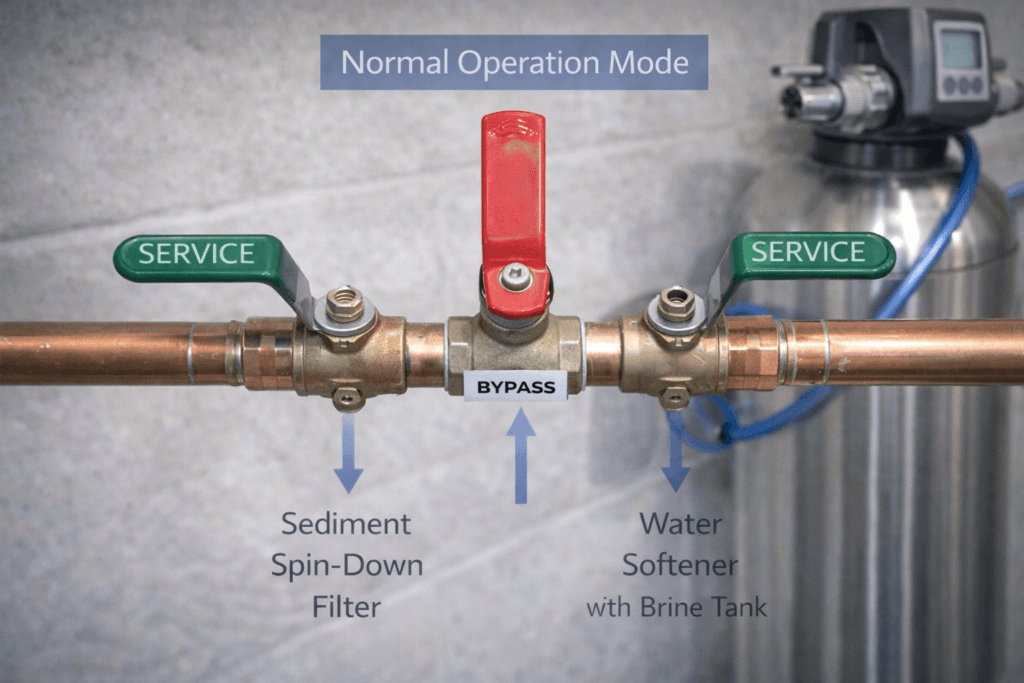
Every professional POE system should be installed with a three-valve bypass. This allows you to divert water around the filtration system in specific scenarios without losing water to the rest of the house:
- Outdoor Usage: Bypass the system when watering the lawn or washing the car to save your expensive filtration media for indoor use.
- System Leaks: If a housing cracks or a valve fails, the bypass stops the leak while allowing the family to still use toilets and sinks.
- Testing: Use the bypass to compare “Raw” water vs. “Filtered” water to verify the antidote’s effectiveness.
| Maintenance Task | Frequency | DIY or Pro? | Warning Signs |
| Sediment Filter Change | 3 – 6 Months | DIY | Visible dirt / Pressure drop |
| Housing Sanitization | Annual | DIY | Musty smell in water |
| Media Re-Bedding | 5 – 10 Years | Pro | Chlorine smell returns |
| Valve/Seal Inspection | Annual | Pro | Small leaks around tank |
| UV Bulb Replacement | 12 Months | DIY | Alarm beep / Indicator light |
By maintaining the integrity of this “Point-of-Entry” gatekeeper, you ensure that every faucet in your home remains a source of high-quality, safe, and pleasant water.
FAQs
Does a whole-house filter remove lead and PFAS?
While many whole-house carbon systems are rated for lead and PFAS reduction, they are typically less effective at 10+ GPM than a localized under-sink RO system. For total protection, use the whole-house system as a “Pre-Filter” for an under-sink RO.
Can I use a whole-house filter instead of a water softener?
No. Filters remove chemicals and particles; softeners remove dissolved minerals. If your water is hard, a filter will not prevent scale buildup in your pipes.
Will a whole-house filter reduce my water pressure?
If sized correctly for your “Peak Flow Rate,” the pressure drop should be unnoticeable (less than 2–3 PSI).
Do whole-house filters waste water?
Cartridge systems waste zero water. Tank-based systems “backwash” periodically to clean the media, which typically uses 20–50 gallons per cycle.
How much space do I need for installation?
A standard tank-based system needs about a 2′ x 3′ footprint near your main water line and access to a drain and electrical outlet.