
Countertop System
AquaTru Classic Countertop Reverse-Osmosis Purifier (AT2000)
Certified for PFOA and PFOS · NSF/ANSI 53
The certificate must name PFOA and PFOS. “PFAS” on the box isn’t enough.
PFAS, the “forever chemicals”, are best reduced at home by a filter certified for PFOA and PFOS: either reverse osmosis or certified activated carbon. Check that the certification names those compounds for the exact model; the word “PFAS” on a box isn’t enough. A filter at your kitchen tap covers the water you drink and cook with.
Why PFAS matter in tap water
PFAS are a family of man-made chemicals used in non-stick, stain-resistant and waterproof products and in firefighting foam. They break down very slowly, so they build up in water and in people.
The federal limits and their status are listed below. Compliance with the 2024 limits is judged on a running annual average, with a compliance date of 2029 (EPA has proposed allowing until 2031 for PFOA and PFOS).
What to look for on the box
Look up the exact model in the free NSF, WQA or IAPMO online listings.
How to read a certification →NSF/ANSI 53 or 58, with PFOA and PFOS named.
The exact model on the certificate, in the free NSF, WQA or IAPMO online listings.
The certified capacity in gallons, and the cartridge schedule.
Caution with “removes PFAS” claims that have no certificate, or “tested to NSF standards”.
The three technologies that work
Some pitchers and faucet filters are certified for a combined “total PFAS” measure rather than for PFOA and PFOS by name. Check what the certificate lists.
A very fine membrane holds back PFAS and other contaminants. Certified models commonly cover PFOA, PFOS and lead (check the listing for arsenic or nitrate). The broadest option, but it sends some water to the drain.
Certified carbon blocks trap PFOA and PFOS as water passes through. Cheaper and no wastewater, but the cartridge must be changed on time.
Special resin beads that grab PFAS. Mostly used in whole-house and larger systems.
Certified carbon filters cost less than reverse osmosis, both to buy and to run. With either, the ongoing cost is replacement cartridges, which must be changed on time for the filter to keep working, so check their price before you choose.
Federal PFAS limits
EPA's 2024 drinking-water rule set maximum contaminant levels of 4.0 ng/L for PFOA and for PFOS, and 10 ng/L for PFHxS, PFNA and HFPO-DA (GenX). In May 2026 EPA proposed keeping the PFOA and PFOS limits, with the option of until 2031 to comply, and rescinding the other three. Until a final rule, all five limits apply.EPA’s 2024 drinking-water rule, and what EPA proposed in May 2026. Until a final rule, all five limits apply.
The 2024 rule also set a Hazard Index of 1 for mixtures of two or more of PFHxS, PFNA, GenX and PFBS; EPA has proposed rescinding it, and it applies until a final rule.
Before you buy, check what is in your water. Your water system’s record shows which contaminants have been found, so you only pay for treatment you need.
Check my water →Each card shows whether the model is certified for PFOA and PFOS. Open a product to see its certificate. Some links are affiliate links: PurityMap may earn from qualifying purchases, at no extra cost to you.
Certified for PFOA and PFOS · NSF/ANSI 53
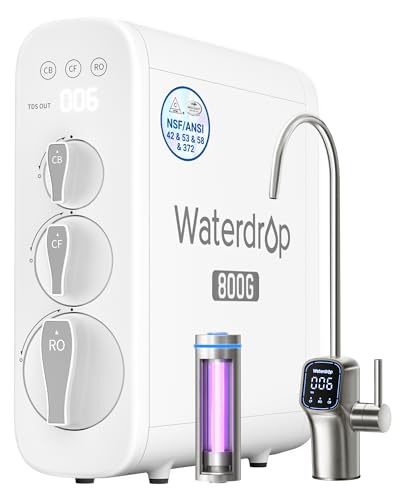
Certified for PFOA and PFOS · NSF/ANSI 53

Certified for PFOA and PFOS · NSF/ANSI 53

Certified for PFOA and PFOS · NSF/ANSI 53

Certified for PFOA and PFOS · NSF/ANSI 53
Every product here is listed for its type and what its certification covers, not for what is in your water. We don’t accept paid placement. Affiliate disclosure.
Questions
Reverse osmosis and activated-carbon filters certified under NSF/ANSI 53 or 58 with a PFOA/PFOS reduction claim are common certified options; other filter types can also carry these claims, so check the listing. Anion exchange is also used, often in whole-house systems.
A certification covers the exact model and the specific claim tested. Verify your model number in the official NSF, WQA, or IAPMO registry. A brand carrying a certification on one product does not extend it to every product it sells.
Start with your city water report and its PFAS finding. If a PFOA or PFOS sample on record is above EPA's 2024 limit, this guide applies; if no PFAS result is published, that can mean it wasn’t tested, not that it’s absent: check whether your system was tested, and test a private well.