Maryland well water by county: arsenic and nitrate
Modelled arsenic and nitrate for private-well users in every Maryland county, what to test for, and where to find a certified lab. Private wells aren’t covered by the Safe Drinking Water Act.
All 24 counties
- Anne Arundel CountyWell users 86,000Arsenic about 4 in 100Nitrate 0.4 mg/L
- Frederick CountyWell users 59,400Arsenic about 3 in 100Nitrate 3.1 mg/L
- Carroll CountyWell users 58,800Arsenic about 3 in 100Nitrate 9.0 mg/L
- Baltimore CountyWell users 58,200Arsenic about 3 in 100Nitrate 4.0 mg/L
- Harford CountyWell users 54,900Arsenic about 2 in 100Nitrate 4.2 mg/L
- St. Mary's CountyWell users 39,900Arsenic about 3 in 100Nitrate 0.0 mg/L
- Cecil CountyWell users 36,000Arsenic about 3 in 100Nitrate 1.7 mg/L
- Wicomico CountyWell users 34,200Arsenic about 2 in 100Nitrate 0.7 mg/L
- Charles CountyWell users 33,800Arsenic about 2 in 100Nitrate 0.0 mg/L
- Montgomery CountyWell users 32,400Arsenic about 4 in 100Nitrate 2.6 mg/L
- Washington CountyWell users 26,600Arsenic about 3 in 100Nitrate 5.0 mg/L
- Calvert CountyWell users 25,700Arsenic about 3 in 100Nitrate 0.0 mg/L
- Queen Anne's CountyWell users 25,000Arsenic about 4 in 100Nitrate 0.0 mg/L
- Howard CountyWell users 24,000Arsenic about 3 in 100Nitrate 5.3 mg/L
- Caroline CountyWell users 21,000Arsenic about 3 in 100Nitrate 0.1 mg/L
- Garrett CountyWell users 16,500Arsenic about 4 in 100Nitrate 0.1 mg/L
- Worcester CountyWell users 15,400Arsenic about 3 in 100Nitrate 0.1 mg/L
- Talbot CountyWell users 15,200Arsenic about 4 in 100Nitrate 0.0 mg/L
- Somerset CountyWell users 13,700Arsenic about 3 in 100Nitrate 0.0 mg/L
- Prince George's CountyWell users 13,600Arsenic about 2 in 100Nitrate 0.0 mg/L
- Dorchester CountyWell users 12,900Arsenic about 3 in 100Nitrate 0.1 mg/L
- Allegany CountyWell users 12,900Arsenic about 3 in 100Nitrate 0.1 mg/L
- Kent CountyWell users 9,200Arsenic about 3 in 100Nitrate 0.4 mg/L
- Baltimore cityWell users 650Arsenic about 3 in 100Nitrate 1.3 mg/L
Each mark = 1 in 100 well users the model places above 10 µg/L arsenic (scale 0–10)10 mg/L nitrate: the federal limit (MCL) for public systems
- These figures describe the area, not your well. Only a lab test shows what’s in your water.
- CDC says the Well Water Index figures “do not describe risk to individual wells.” (CDC Tracking Network)
- The arsenic model is better at spotting low-arsenic areas than at confirming high ones.
- Well-user counts are 2010 USGS estimates; tract values are averages over each census tract.
- Total coliform bacteriaEvery year
- NitrateEvery year
- Total dissolved solidsEvery year
- pHEvery year
- ArsenicAsk your local health department
Order a mail-in lab test or a screening kit ↓
Got your results back? Read them →
EPA: Private Drinking Water Wells · CDC: Guidelines for Testing Well Water
Use a state-certified lab
Maryland Department of the Environment lists the laboratories certified to test drinking water in Maryland.
What Maryland says
- What a new well is tested for
In Maryland a well used for drinking may not be put into service until the local approving authority issues a Certificate of Potability.
Maryland Department of the Environment (COMAR 26.04.04.30, Library of Maryland Regulations) · Checked Nov 8, 2026
- What a new well is tested for
For a private (nonpublic) drinking-water well, the Certificate of Potability requires two coliform-negative samples at least 24 hours apart, plus water that meets the nitrate limit and turbidity standards.
Maryland Department of the Environment (COMAR 26.04.04.30, Library of Maryland Regulations) · Checked Nov 8, 2026
- Disclosing a well when a home is sold
Maryland home sellers must give buyers either a property condition disclosure statement or a disclaimer statement; the disclosure form covers known defects in water systems, including the source of household water.
Maryland General Assembly (Real Property Article § 10-702) · Checked Nov 8, 2026
- How often to test for arsenic
University of Maryland Extension lists arsenic, where it is a local concern, among tests to do initially or every 3 years, and says to check with the local health department for specific recommendations.
University of Maryland Extension · Checked Nov 8, 2026
- How often to test well water for radon
University of Maryland Extension lists radon, where it is a local concern, among well water tests to do initially or every 3 years, and says to check with the local health department for specific recommendations.
University of Maryland Extension · Checked Nov 8, 2026
- We found no statewide Maryland rule on testing a well when a home is sold (checked Nov 8, 2026). A county or town may have one: ask your local health department.
Rules can change. Check the linked page before you rely on it.
Screening tells you if something is worth a closer look
A lab result is the number you can act on.
As an Amazon Associate, PurityMap earns from qualifying purchases. Affiliate disclosure
Mail-in lab test
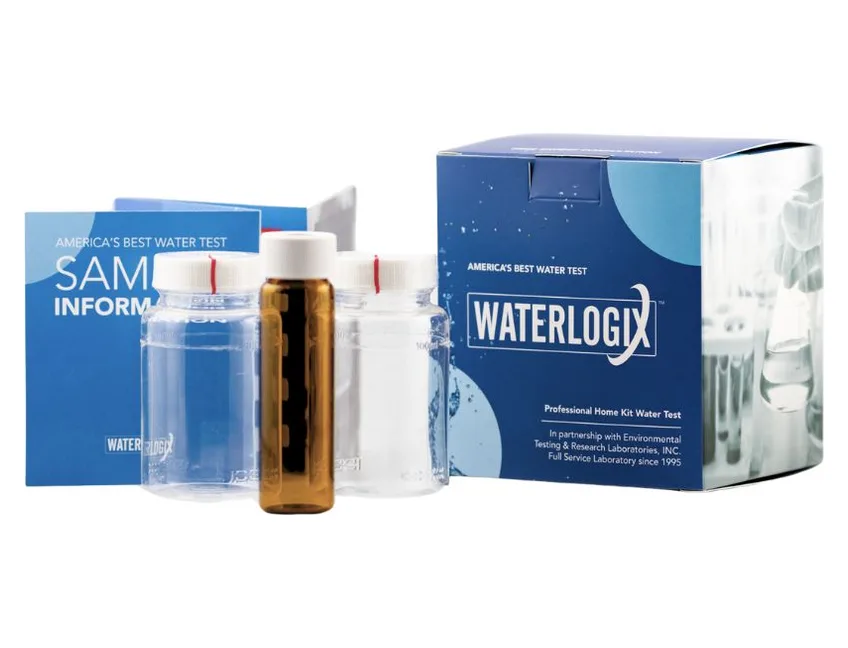
Waterlogix Advanced Well Water Test
US Water Systems (Waterlogix)
Manufacturer states: 56 well water contaminants by lab analysis, including coliform bacteria, nitrate, arsenic, lead and hardness, plus an on-site kit for iron-related and sulfate-reducing bacteria and hydrogen sulfide
- Analyzed by A lab the product page does not name · Manufacturer states: certified. The kit box says “in partnership with Environmental Testing & Research Laboratories, Inc.” We have not seen any certificate for this lab.
- Manufacturer states: Turnaround: 3–5 business days after the lab receives it
What it can't tell you: US Water Systems’ product page names no lab. Its kit box says “in partnership with Environmental Testing & Research Laboratories, Inc.”, and we have not seen any certificate for that lab or this test. US Water Systems says most customers get results and a treatment plan within about two weeks of ordering (one reviewer says about 2 weeks), and that plan comes from a company that sells treatment systems. It does not list PFAS. One sample shows one tap on one day.
Screening: quick check, not lab-grade

Watersafe Drinking Water Test Kit
Silver Lake Research
Lead, bacteria, nitrate, copper, iron, chlorine, hardness and pH
- Turnaround: Minutes; the bacteria test can take up to 48 hours
What it can't tell you: Each test gives a yes/no or a rough range, not a lab number, and it cannot detect PFAS or arsenic.
A mail-in kit’s lab is accredited (ISO/IEC 17025) but may not be certified by your state. For a home sale, a loan, or a health-department follow-up, use a state-certified lab.
Maryland well water
Sources: CDC Well Water Index (2024) · USGS arsenic and nitrate models · USGS domestic well populations · EPA and CDC testing guidance. Data last updated 2026-11-09. All sources →
How many people use private wells in Maryland?
About 726,100 people across 24 Maryland counties, by the USGS 2010 estimate. USGS models place about 22,300 of them in areas where wells are likely to be above the 10 µg/L arsenic limit. These are area estimates, not well results.
Are private wells regulated in Maryland?
The quality and safety of drinking water from private domestic wells are not regulated by the Federal Government under the Safe Drinking Water Act nor by most state governments and laws. (EPA) Testing and treatment are the owner's responsibility.
Where can I get my well tested in Maryland?
Maryland Department of the Environment keeps the list of laboratories certified to test drinking water in Maryland. Only use laboratories that are certified to do drinking water testing. (EPA)