Linn County, OR well water testing: arsenic, nitrate and what to test for
Test a Linn County well every year for coliform bacteria, nitrate, total dissolved solids and pH (EPA and CDC), and ask your local health department about arsenic: a USGS model places about 4 in 100 local well users where wells are likely above the arsenic limit. About 41,800 people in Linn County use a private well (USGS 2010 estimate). Private wells aren’t covered by the Safe Drinking Water Act, so only a lab test shows what’s in yours.
“Test your well water at least once every year for total coliform bacteria, nitrates, total dissolved solids, and pH level.”
CDC- Total coliform bacteriaEvery year
- NitrateEvery year
- Total dissolved solidsEvery year
- pHEvery year
- ArsenicAsk your local health department how often
The model puts about 4 in 100 here above the limit. Only a test shows your well.
Order a mail-in lab test or a screening kit ↓
Got your results back? Read them →
What coliform in well water means · Nitrate, arsenic and radon basics · What a well test costs · Treating well water · Well water smells like rotten eggs
EPA: Private Drinking Water Wells · EPA: Protect Your Home’s Water · CDC: Guidelines for Testing Well Water
- After flooding or land disturbance near the well
- After the well is repaired or a part is replaced
- When the water’s taste, color or smell changes
- If someone in the home becomes pregnant
- When an infant or child joins the household
- These figures describe the area, not your well. Only a lab test shows what’s in your water.
- CDC says the Well Water Index figures “do not describe risk to individual wells.” (CDC Tracking Network)
- The arsenic model is better at spotting low-arsenic areas than at confirming high ones.
- Well-user counts are 2010 USGS estimates; tract values are averages over each census tract.
Agency well tests (USGS and state, tribal and local agencies)
| Substance | Wells over the standard | Standard used | Years |
|---|---|---|---|
| Total coliform bacteria | 4 of 23 wells (17%) | Any present | 2002–2017 |
| E. coli | 1 of 24 wells (4%) | Any present | 2002–2017 |
| Nitrate + nitrite (as N) | 2 of 32 wells (6%) | 10 mg/L (EPA limit for public water) | 1993–2012 |
| Arsenic | 2 of 101 wells (2%) | 10 µg/L (EPA limit for public water) | 1993–2017 |
| Lead | 2 of 74 wells (3%) | 15 µg/L (EPA action level for public water, a trigger for treatment, not a limit) | 1993–2017 |
| Uranium | 0 of 21 wells (0%) | 30 µg/L (EPA limit for public water) | 1993–2017 |
| Manganese | 23 of 84 wells (27%) | 0.05 mg/L (EPA secondary, not a health limit: taste and staining) | 1993–2017 |
- These are wells that USGS and state, tribal and local agencies sampled for studies and monitoring. They include monitoring and public-supply wells, not only home wells, so they can’t tell you what’s in your well.
- A well counts once, and counts as over if any of its samples since 1990 was over the standard. USGS results in this source stop in early 2024.
Source: Water Quality Portal (run by USGS, EPA and the National Water Quality Monitoring Council), well samples since 1990 (retrieved 2026-11-09).
Only a test of your own well can tell.
Among the lowest for arsenic, mid-table for nitrate
Use a state-certified lab
Oregon Health Authority certifies the laboratories that test drinking water in Oregon.
On city water instead? Your utility publishes results. See what it reported.
Linn County water report →Screening tells you if something is worth a closer look
A lab result is the number you can act on.
As an Amazon Associate, PurityMap earns from qualifying purchases. Affiliate disclosure
Mail-in lab test
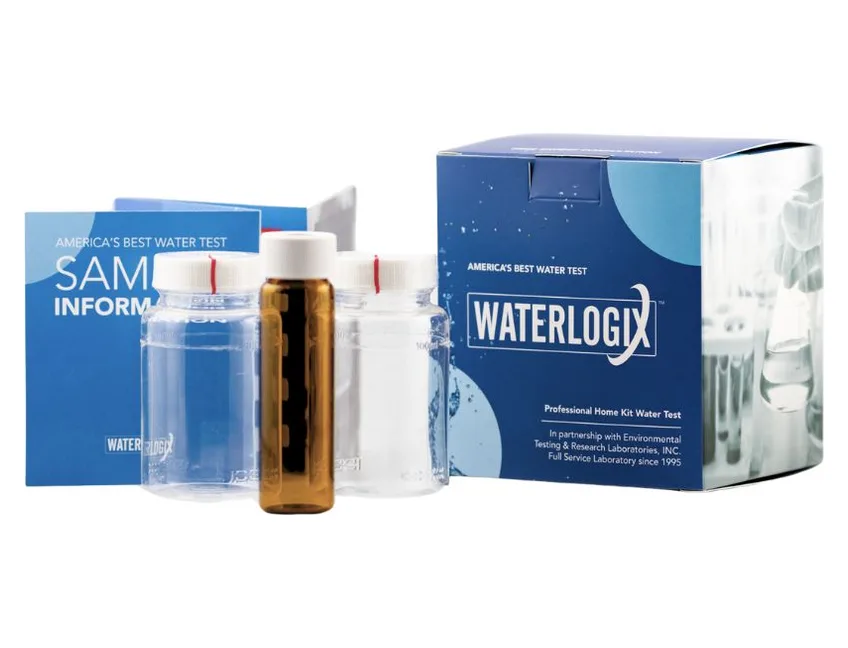
Waterlogix Advanced Well Water Test
US Water Systems (Waterlogix)
Manufacturer states: 56 well water contaminants by lab analysis, including coliform bacteria, nitrate, arsenic, lead and hardness, plus an on-site kit for iron-related and sulfate-reducing bacteria and hydrogen sulfide
- Analyzed by A lab the product page does not name · Manufacturer states: certified. The kit box says “in partnership with Environmental Testing & Research Laboratories, Inc.” We have not seen any certificate for this lab.
- Manufacturer states: Turnaround: 3–5 business days after the lab receives it
What it can't tell you: US Water Systems’ product page names no lab. Its kit box says “in partnership with Environmental Testing & Research Laboratories, Inc.”, and we have not seen any certificate for that lab or this test. US Water Systems says most customers get results and a treatment plan within about two weeks of ordering (one reviewer says about 2 weeks), and that plan comes from a company that sells treatment systems. It does not list PFAS. One sample shows one tap on one day.
Screening: quick check, not lab-grade

Watersafe Drinking Water Test Kit
Silver Lake Research
Lead, bacteria, nitrate, copper, iron, chlorine, hardness and pH
- Turnaround: Minutes; the bacteria test can take up to 48 hours
What it can't tell you: Each test gives a yes/no or a rough range, not a lab number, and it cannot detect PFAS or arsenic.
A mail-in kit’s lab is accredited (ISO/IEC 17025) but may not be certified by your state. For a home sale, a loan, or a health-department follow-up, use a state-certified lab.
If your lab test finds arsenic, nitrate or hard water
Only a lab test of your own well shows what’s in it; the area estimates on this page are not one. Retest to confirm a high result and talk to your local health department before you buy.
As an Amazon Associate, PurityMap earns from qualifying purchases. Affiliate disclosure
Arsenic
Retest to confirm and contact your health department. Treatment is usually a point-of-use system certified to reduce that contaminant, such as reverse osmosis at the tap you drink from.
These certifications cover arsenic V only. Arsenic III, common in well water, is not covered unless a pre-treatment step such as chlorination first converts it to arsenic V. A standard test reports total arsenic; ask your lab whether it can test which form is present.
- AquaTru Carafe Countertop Reverse-Osmosis Purifier (AT100)AquaTruCertified for Arsenic V (NSF/ANSI 58, IAPMO)Check price on Amazon
- AquaTru Classic Countertop Reverse-Osmosis Purifier (AT2000)AquaTruCertified for Arsenic V (NSF/ANSI 58, IAPMO)Check price on Amazon
Nitrate
Retest to confirm and contact your health department. Treatment is usually a point-of-use system certified to reduce that contaminant, such as reverse osmosis at the tap you drink from.
- AquaTru Carafe Countertop Reverse-Osmosis Purifier (AT100)AquaTruCertified for Nitrate/nitrite (NSF/ANSI 58, IAPMO)Check price on Amazon
- AquaTru Classic Countertop Reverse-Osmosis Purifier (AT2000)AquaTruCertified for Nitrate/nitrite (NSF/ANSI 58, IAPMO)Check price on Amazon
Hard water
A water softener, sized from your hardness result. It does not treat bacteria, nitrate or arsenic.
- GE GXSH35W Water Softener (35,000-grain)GE AppliancesCertified for Hardness / scale (NSF/ANSI 44, IAPMO)Check price on Amazon
- Kenmore 420 Water Softener (40,000-grain)KenmoreCertified for Hardness / scale (NSF/ANSI 44, NSF)Check price on Amazon
Coliform bacteria, iron and manganese: no product we list is certified for them yet. Treating well water has the steps for each result.
Linn County well water
Sources: CDC Well Water Index (2024) · USGS arsenic and nitrate models · USGS domestic well populations · EPA and CDC testing guidance · EPA state certification programs. Data last updated 2026-11-09. All sources →
Do private wells in Linn County have arsenic?
A USGS model estimates that about 4 in 100 of the 41,800 people on private wells in Linn County live where wells are likely to be above the 10 µg/L arsenic limit (about 1,500 people). That is an estimate for the area, not a result for any well. Only a lab test of your own well shows what is in your water.
What should I test my well for in Linn County?
EPA and CDC say to test every year for total coliform bacteria, nitrate, total dissolved solids and pH. Ask your local health department about arsenic; in Linn County the USGS model puts about 4 in 100 well users above the arsenic limit. The USGS nitrate model's typical level at well depth here is 0.1 mg/L.
How often should I test my well water?
Test your well water at least once every year for total coliform bacteria, nitrates, total dissolved solids, and pH level. (CDC) Test again after flooding, a well repair, or a change in taste, color or smell, and when someone in the home is pregnant or an infant joins the household.
Where can I get my well tested in Oregon?
Oregon Health Authority keeps the list of laboratories certified to test drinking water in Oregon. Only use laboratories that are certified to do drinking water testing. (EPA)
How much does well water testing cost in Linn County?
Ask your local health department first: EPA notes it may test private wells for free. Otherwise the price depends on the lab and on how many things you test for. For a home sale or a loan, use a lab certified by your state.