Texas well water by county: arsenic and nitrate
Modelled arsenic and nitrate for private-well users in every Texas county, what to test for, and where to find a certified lab. Private wells aren’t covered by the Safe Drinking Water Act.
All 254 counties
- Harris CountyWell users 99,300Arsenic about 3 in 100Nitrate 0.0 mg/L
- Brazoria CountyWell users 55,500Arsenic about 3 in 100Nitrate 0.0 mg/L
- Montgomery CountyWell users 48,600Arsenic about 2 in 100Nitrate 0.0 mg/L
- Fort Bend CountyWell users 37,000Arsenic about 2 in 100Nitrate 0.0 mg/L
- Parker CountyWell users 35,400Arsenic about 3 in 100Nitrate 0.6 mg/L
- Lubbock CountyWell users 31,500Arsenic about 38 in 100Nitrate 9.7 mg/L
- Ector CountyWell users 30,700Arsenic about 24 in 100Nitrate 4.0 mg/L
- Liberty CountyWell users 30,200Arsenic about 2 in 100Nitrate 0.0 mg/L
- Orange CountyWell users 29,600Arsenic about 1 in 100Nitrate 0.0 mg/L
- Wise CountyWell users 29,000Arsenic about 3 in 100Nitrate 0.7 mg/L
- Bexar CountyWell users 27,100Arsenic about 2 in 100Nitrate 0.7 mg/L
- Comal CountyWell users 24,500Arsenic about 1 in 100Nitrate 0.3 mg/L
- Midland CountyWell users 24,300Arsenic about 25 in 100Nitrate 5.4 mg/L
- Hays CountyWell users 21,100Arsenic about 1 in 100Nitrate 0.2 mg/L
- Bowie CountyWell users 20,900Arsenic about 1 in 100Nitrate 0.2 mg/L
- Tarrant CountyWell users 19,500Arsenic about 3 in 100Nitrate 0.1 mg/L
- Denton CountyWell users 18,200Arsenic about 2 in 100Nitrate 0.1 mg/L
- Wharton CountyWell users 17,700Arsenic about 3 in 100Nitrate 0.2 mg/L
- Victoria CountyWell users 17,600Arsenic about 6 in 100Nitrate 0.3 mg/L
- El Paso CountyWell users 17,000Arsenic about 29 in 100Nitrate 0.5 mg/L
- Waller CountyWell users 16,500Arsenic about 2 in 100Nitrate 0.0 mg/L
- Hardin CountyWell users 16,300Arsenic about 1 in 100Nitrate 0.0 mg/L
- Jasper CountyWell users 16,000Arsenic about 1 in 100Nitrate 0.0 mg/L
- Cass CountyWell users 15,900Arsenic about 1 in 100Nitrate 0.0 mg/L
- Williamson CountyWell users 15,800Arsenic about 1 in 100Nitrate 0.5 mg/L
- Erath CountyWell users 15,400Arsenic about 2 in 100Nitrate 0.4 mg/L
- Kendall CountyWell users 15,100Arsenic about 1 in 100Nitrate 0.2 mg/L
- Washington CountyWell users 14,700Arsenic about 2 in 100Nitrate 0.2 mg/L
- Austin CountyWell users 14,700Arsenic about 2 in 100Nitrate 0.2 mg/L
- Travis CountyWell users 14,500Arsenic about 2 in 100Nitrate 0.6 mg/L
- Burnet CountyWell users 14,400Arsenic about 2 in 100Nitrate 0.4 mg/L
- Randall CountyWell users 14,200Arsenic about 3 in 100Nitrate 3.0 mg/L
- Galveston CountyWell users 14,100Arsenic about 4 in 100Nitrate 0.0 mg/L
- Grimes CountyWell users 14,000Arsenic about 2 in 100Nitrate 0.0 mg/L
- Bee CountyWell users 13,600Arsenic about 38 in 100Nitrate 0.6 mg/L
- Bandera CountyWell users 13,100Arsenic about 1 in 100Nitrate 0.1 mg/L
- Hidalgo CountyWell users 12,900Arsenic about 30 in 100Nitrate 1.3 mg/L
- Walker CountyWell users 12,600Arsenic about 2 in 100Nitrate 0.0 mg/L
- Van Zandt CountyWell users 12,600Arsenic about 2 in 100Nitrate 0.1 mg/L
- Harrison CountyWell users 12,500Arsenic about 1 in 100Nitrate 0.0 mg/L
- Gillespie CountyWell users 12,300Arsenic about 2 in 100Nitrate 1.0 mg/L
- Jim Wells CountyWell users 12,100Arsenic about 39 in 100Nitrate 0.3 mg/L
- Atascosa CountyWell users 12,100Arsenic about 2 in 100Nitrate 0.2 mg/L
- Cameron CountyWell users 11,900Arsenic about 7 in 100Nitrate 1.3 mg/L
- Potter CountyWell users 11,600Arsenic about 5 in 100Nitrate 2.6 mg/L
- Henderson CountyWell users 11,500Arsenic about 2 in 100Nitrate 0.3 mg/L
- Smith CountyWell users 11,000Arsenic about 2 in 100Nitrate 0.1 mg/L
- Kerr CountyWell users 10,700Arsenic about 1 in 100Nitrate 0.3 mg/L
- Tom Green CountyWell users 10,500Arsenic about 3 in 100Nitrate 3.6 mg/L
- Fayette CountyWell users 10,200Arsenic about 3 in 100Nitrate 0.3 mg/L
- Lavaca CountyWell users 10,100Arsenic about 4 in 100Nitrate 0.3 mg/L
- San Jacinto CountyWell users 10,000Arsenic about 2 in 100Nitrate 0.0 mg/L
- Colorado CountyWell users 9,900Arsenic about 4 in 100Nitrate 0.3 mg/L
- Medina CountyWell users 9,800Arsenic about 2 in 100Nitrate 1.4 mg/L
- Guadalupe CountyWell users 9,400Arsenic about 3 in 100Nitrate 1.0 mg/L
- Johnson CountyWell users 9,400Arsenic about 3 in 100Nitrate 0.0 mg/L
- Hood CountyWell users 9,200Arsenic about 2 in 100Nitrate 0.2 mg/L
- Grayson CountyWell users 9,000Arsenic about 2 in 100Nitrate 0.1 mg/L
- Polk CountyWell users 8,900Arsenic about 2 in 100Nitrate 0.0 mg/L
- Brazos CountyWell users 8,800Arsenic about 2 in 100Nitrate 0.0 mg/L
- Chambers CountyWell users 8,500Arsenic about 3 in 100Nitrate 0.0 mg/L
- Matagorda CountyWell users 8,500Arsenic about 3 in 100Nitrate 0.0 mg/L
- Upshur CountyWell users 8,400Arsenic about 2 in 100Nitrate 0.0 mg/L
- Wilson CountyWell users 8,300Arsenic about 3 in 100Nitrate 0.1 mg/L
- San Patricio CountyWell users 7,800Arsenic about 15 in 100Nitrate 0.3 mg/L
- Nueces CountyWell users 7,600Arsenic about 15 in 100Nitrate 0.3 mg/L
- Newton CountyWell users 7,600Arsenic about 1 in 100Nitrate 0.0 mg/L
- Tyler CountyWell users 7,600Arsenic about 1 in 100Nitrate 0.1 mg/L
- Montague CountyWell users 7,600Arsenic about 4 in 100Nitrate 1.2 mg/L
- Cooke CountyWell users 7,500Arsenic about 2 in 100Nitrate 0.1 mg/L
- DeWitt CountyWell users 7,400Arsenic about 6 in 100Nitrate 0.4 mg/L
- Dallas CountyWell users 7,400Arsenic about 7 in 100Nitrate 0.7 mg/L
- Gaines CountyWell users 7,300Arsenic about 61 in 100Nitrate 7.3 mg/L
- Hale CountyWell users 7,000Arsenic about 6 in 100Nitrate 3.3 mg/L
- Bastrop CountyWell users 6,700Arsenic about 2 in 100Nitrate 0.2 mg/L
- Panola CountyWell users 6,700Arsenic about 2 in 100Nitrate 0.0 mg/L
- Bell CountyWell users 6,600Arsenic about 2 in 100Nitrate 0.4 mg/L
- Rusk CountyWell users 6,400Arsenic about 1 in 100Nitrate 0.0 mg/L
- Titus CountyWell users 6,400Arsenic about 2 in 100Nitrate 0.5 mg/L
- Comanche CountyWell users 6,300Arsenic about 5 in 100Nitrate 1.8 mg/L
- Blanco CountyWell users 6,100Arsenic about 1 in 100Nitrate 0.2 mg/L
- Anderson CountyWell users 6,000Arsenic about 2 in 100Nitrate 0.1 mg/L
- Leon CountyWell users 5,900Arsenic about 2 in 100Nitrate 0.0 mg/L
- Angelina CountyWell users 5,800Arsenic about 1 in 100Nitrate 0.0 mg/L
- Madison CountyWell users 5,600Arsenic about 2 in 100Nitrate 0.0 mg/L
- Wood CountyWell users 5,600Arsenic about 2 in 100Nitrate 0.1 mg/L
- Cherokee CountyWell users 5,500Arsenic about 1 in 100Nitrate 0.1 mg/L
- Callahan CountyWell users 5,500Arsenic about 2 in 100Nitrate 2.5 mg/L
- Shelby CountyWell users 5,500Arsenic about 2 in 100Nitrate 0.0 mg/L
- Hockley CountyWell users 5,400Arsenic about 41 in 100Nitrate 8.0 mg/L
- Uvalde CountyWell users 5,300Arsenic about 2 in 100Nitrate 1.0 mg/L
- Somervell CountyWell users 5,200Arsenic about 2 in 100Nitrate 0.1 mg/L
- Houston CountyWell users 5,200Arsenic about 2 in 100Nitrate 0.1 mg/L
- Jefferson CountyWell users 5,000Arsenic about 1 in 100Nitrate 0.0 mg/L
- Scurry CountyWell users 5,000Arsenic about 15 in 100Nitrate 3.7 mg/L
- Jackson CountyWell users 4,900Arsenic about 4 in 100Nitrate 0.2 mg/L
- Frio CountyWell users 4,900Arsenic about 3 in 100Nitrate 0.6 mg/L
- Burleson CountyWell users 4,900Arsenic about 2 in 100Nitrate 0.0 mg/L
- Live Oak CountyWell users 4,900Arsenic about 21 in 100Nitrate 0.8 mg/L
- Marion CountyWell users 4,800Arsenic about 1 in 100Nitrate 0.0 mg/L
- Jack CountyWell users 4,800Arsenic about 9 in 100Nitrate 1.5 mg/L
- Goliad CountyWell users 4,700Arsenic about 14 in 100Nitrate 0.3 mg/L
- Howard CountyWell users 4,600Arsenic about 12 in 100Nitrate 7.8 mg/L
- Llano CountyWell users 4,600Arsenic about 4 in 100Nitrate 1.3 mg/L
- Nacogdoches CountyWell users 4,400Arsenic about 1 in 100Nitrate 0.0 mg/L
- Coryell CountyWell users 4,300Arsenic about 1 in 100Nitrate 0.1 mg/L
- Karnes CountyWell users 4,200Arsenic about 10 in 100Nitrate 0.4 mg/L
- Morris CountyWell users 4,100Arsenic about 2 in 100Nitrate 0.1 mg/L
- Gonzales CountyWell users 4,000Arsenic about 2 in 100Nitrate 0.2 mg/L
- San Augustine CountyWell users 4,000Arsenic about 1 in 100Nitrate 0.0 mg/L
- Ellis CountyWell users 4,000Arsenic about 3 in 100Nitrate 0.2 mg/L
- Andrews CountyWell users 3,900Arsenic about 72 in 100Nitrate 7.1 mg/L
- Hamilton CountyWell users 3,900Arsenic about 1 in 100Nitrate 0.2 mg/L
- Bosque CountyWell users 3,900Arsenic about 1 in 100Nitrate 0.1 mg/L
- Caldwell CountyWell users 3,800Arsenic about 2 in 100Nitrate 0.8 mg/L
- Limestone CountyWell users 3,700Arsenic about 2 in 100Nitrate 0.1 mg/L
- Robertson CountyWell users 3,700Arsenic about 2 in 100Nitrate 0.0 mg/L
- Palo Pinto CountyWell users 3,600Arsenic about 7 in 100Nitrate 0.9 mg/L
- Aransas CountyWell users 3,600Arsenic about 9 in 100Nitrate 0.0 mg/L
- Lampasas CountyWell users 3,600Arsenic about 2 in 100Nitrate 0.7 mg/L
- McLennan CountyWell users 3,500Arsenic about 2 in 100Nitrate 0.6 mg/L
- Deaf Smith CountyWell users 3,400Arsenic about 5 in 100Nitrate 4.0 mg/L
- Gregg CountyWell users 3,400Arsenic about 1 in 100Nitrate 0.0 mg/L
- Pecos CountyWell users 3,300Arsenic about 4 in 100Nitrate 1.4 mg/L
- Camp CountyWell users 3,300Arsenic about 2 in 100Nitrate 0.0 mg/L
- Calhoun CountyWell users 3,200Arsenic about 6 in 100Nitrate 0.0 mg/L
- Kaufman CountyWell users 3,200Arsenic about 2 in 100Nitrate 1.3 mg/L
- Milam CountyWell users 3,100Arsenic about 1 in 100Nitrate 0.6 mg/L
- Dawson CountyWell users 3,000Arsenic about 82 in 100Nitrate 14.7 mg/L
- Fannin CountyWell users 3,000Arsenic about 2 in 100Nitrate 0.7 mg/L
- Sabine CountyWell users 3,000Arsenic about 1 in 100Nitrate 0.0 mg/L
- Eastland CountyWell users 3,000Arsenic about 4 in 100Nitrate 2.7 mg/L
- Lee CountyWell users 2,900Arsenic about 2 in 100Nitrate 0.0 mg/L
- Gray CountyWell users 2,900Arsenic about 3 in 100Nitrate 1.9 mg/L
- Duval CountyWell users 2,800Arsenic about 36 in 100Nitrate 0.4 mg/L
- Mills CountyWell users 2,700Arsenic about 3 in 100Nitrate 0.9 mg/L
- Kleberg CountyWell users 2,700Arsenic about 15 in 100Nitrate 0.0 mg/L
- Parmer CountyWell users 2,700Arsenic about 15 in 100Nitrate 3.3 mg/L
- Hunt CountyWell users 2,700Arsenic about 2 in 100Nitrate 0.1 mg/L
- Swisher CountyWell users 2,600Arsenic about 3 in 100Nitrate 4.4 mg/L
- Val Verde CountyWell users 2,500Arsenic about 3 in 100Nitrate 0.8 mg/L
- Terry CountyWell users 2,500Arsenic about 60 in 100Nitrate 13.2 mg/L
- Dimmit CountyWell users 2,500Arsenic about 4 in 100Nitrate 0.2 mg/L
- Clay CountyWell users 2,500Arsenic about 12 in 100Nitrate 4.6 mg/L
- Taylor CountyWell users 2,400Arsenic about 3 in 100Nitrate 4.0 mg/L
- Lamar CountyWell users 2,400Arsenic about 2 in 100Nitrate 0.6 mg/L
- Lynn CountyWell users 2,400Arsenic about 32 in 100Nitrate 19.1 mg/L
- Freestone CountyWell users 2,400Arsenic about 2 in 100Nitrate 0.1 mg/L
- Brown CountyWell users 2,300Arsenic about 2 in 100Nitrate 3.1 mg/L
- Lamb CountyWell users 2,300Arsenic about 22 in 100Nitrate 7.6 mg/L
- Hopkins CountyWell users 2,200Arsenic about 2 in 100Nitrate 0.3 mg/L
- Martin CountyWell users 2,200Arsenic about 36 in 100Nitrate 10.9 mg/L
- Collin CountyWell users 2,200Arsenic about 2 in 100Nitrate 0.2 mg/L
- Webb CountyWell users 2,200Arsenic about 9 in 100Nitrate 0.1 mg/L
- Red River CountyWell users 2,100Arsenic about 2 in 100Nitrate 0.4 mg/L
- San Saba CountyWell users 2,100Arsenic about 4 in 100Nitrate 1.5 mg/L
- Jim Hogg CountyWell users 2,100Arsenic about 35 in 100Nitrate 0.3 mg/L
- Real CountyWell users 2,100Arsenic about 1 in 100Nitrate 0.3 mg/L
- Castro CountyWell users 2,000Arsenic about 4 in 100Nitrate 3.7 mg/L
- Hill CountyWell users 2,000Arsenic about 2 in 100Nitrate 0.2 mg/L
- Kimble CountyWell users 2,000Arsenic about 2 in 100Nitrate 0.9 mg/L
- Refugio CountyWell users 1,900Arsenic about 7 in 100Nitrate 0.0 mg/L
- Ward CountyWell users 1,900Arsenic about 12 in 100Nitrate 2.3 mg/L
- Bailey CountyWell users 1,900Arsenic about 17 in 100Nitrate 8.0 mg/L
- Mason CountyWell users 1,900Arsenic about 3 in 100Nitrate 1.3 mg/L
- Yoakum CountyWell users 1,900Arsenic about 52 in 100Nitrate 9.4 mg/L
- Starr CountyWell users 1,800Arsenic about 46 in 100Nitrate 1.3 mg/L
- Brewster CountyWell users 1,800Arsenic about 6 in 100Nitrate 1.5 mg/L
- Hartley CountyWell users 1,700Arsenic about 8 in 100Nitrate 1.9 mg/L
- Young CountyWell users 1,700Arsenic about 9 in 100Nitrate 4.5 mg/L
- Brooks CountyWell users 1,700Arsenic about 16 in 100Nitrate 0.1 mg/L
- Jones CountyWell users 1,600Arsenic about 8 in 100Nitrate 9.2 mg/L
- Falls CountyWell users 1,600Arsenic about 2 in 100Nitrate 1.3 mg/L
- Wilbarger CountyWell users 1,500Arsenic about 4 in 100Nitrate 14.5 mg/L
- Maverick CountyWell users 1,400Arsenic about 3 in 100Nitrate 0.7 mg/L
- Navarro CountyWell users 1,300Arsenic about 2 in 100Nitrate 1.1 mg/L
- Floyd CountyWell users 1,300Arsenic about 13 in 100Nitrate 2.0 mg/L
- Moore CountyWell users 1,300Arsenic about 4 in 100Nitrate 2.3 mg/L
- Schleicher CountyWell users 1,300Arsenic about 2 in 100Nitrate 0.8 mg/L
- Carson CountyWell users 1,300Arsenic about 3 in 100Nitrate 1.5 mg/L
- La Salle CountyWell users 1,300Arsenic about 3 in 100Nitrate 0.1 mg/L
- Wheeler CountyWell users 1,300Arsenic about 3 in 100Nitrate 4.8 mg/L
- Trinity CountyWell users 1,200Arsenic about 2 in 100Nitrate 0.0 mg/L
- Ochiltree CountyWell users 1,200Arsenic about 4 in 100Nitrate 2.3 mg/L
- Concho CountyWell users 1,200Arsenic about 2 in 100Nitrate 2.6 mg/L
- Glasscock CountyWell users 1,200Arsenic about 5 in 100Nitrate 3.4 mg/L
- Runnels CountyWell users 1,200Arsenic about 3 in 100Nitrate 4.5 mg/L
- Upton CountyWell users 1,100Arsenic about 4 in 100Nitrate 2.6 mg/L
- Mitchell CountyWell users 1,100Arsenic about 11 in 100Nitrate 4.3 mg/L
- Zavala CountyWell users 1,100Arsenic about 3 in 100Nitrate 0.4 mg/L
- Nolan CountyWell users 1,100Arsenic about 6 in 100Nitrate 2.8 mg/L
- Wichita CountyWell users 1,000Arsenic about 16 in 100Nitrate 10.0 mg/L
- Jeff Davis CountyWell users 960Arsenic about 14 in 100Nitrate 1.4 mg/L
- McCulloch CountyWell users 950Arsenic about 3 in 100Nitrate 1.7 mg/L
- Hansford CountyWell users 940Arsenic about 5 in 100Nitrate 3.0 mg/L
- Hemphill CountyWell users 930Arsenic about 3 in 100Nitrate 1.5 mg/L
- Hutchinson CountyWell users 920Arsenic about 3 in 100Nitrate 1.7 mg/L
- Irion CountyWell users 920Arsenic about 2 in 100Nitrate 1.4 mg/L
- Presidio CountyWell users 890Arsenic about 20 in 100Nitrate 1.6 mg/L
- Haskell CountyWell users 890Arsenic about 5 in 100Nitrate 11.5 mg/L
- Dallam CountyWell users 880Arsenic about 11 in 100Nitrate 2.7 mg/L
- Rains CountyWell users 860Arsenic about 1 in 100Nitrate 0.4 mg/L
- Crosby CountyWell users 860Arsenic about 15 in 100Nitrate 4.0 mg/L
- Franklin CountyWell users 840Arsenic about 2 in 100Nitrate 0.8 mg/L
- Hudspeth CountyWell users 820Arsenic about 13 in 100Nitrate 1.1 mg/L
- Donley CountyWell users 820Arsenic about 4 in 100Nitrate 5.7 mg/L
- Garza CountyWell users 800Arsenic about 12 in 100Nitrate 5.5 mg/L
- Coke CountyWell users 770Arsenic about 3 in 100Nitrate 2.4 mg/L
- Sutton CountyWell users 730Arsenic about 2 in 100Nitrate 0.7 mg/L
- Edwards CountyWell users 710Arsenic about 2 in 100Nitrate 0.5 mg/L
- Menard CountyWell users 700Arsenic about 2 in 100Nitrate 1.4 mg/L
- Sherman CountyWell users 690Arsenic about 4 in 100Nitrate 2.7 mg/L
- Lipscomb CountyWell users 670Arsenic about 3 in 100Nitrate 2.0 mg/L
- Kinney CountyWell users 630Arsenic about 2 in 100Nitrate 1.0 mg/L
- Armstrong CountyWell users 620Arsenic about 4 in 100Nitrate 2.3 mg/L
- Willacy CountyWell users 600Arsenic about 18 in 100Nitrate 1.7 mg/L
- Cochran CountyWell users 570Arsenic about 27 in 100Nitrate 5.6 mg/L
- Knox CountyWell users 560Arsenic about 4 in 100Nitrate 16.3 mg/L
- Dickens CountyWell users 540Arsenic about 3 in 100Nitrate 2.9 mg/L
- Baylor CountyWell users 520Arsenic about 6 in 100Nitrate 9.7 mg/L
- Briscoe CountyWell users 480Arsenic about 5 in 100Nitrate 3.5 mg/L
- Oldham CountyWell users 480Arsenic about 8 in 100Nitrate 2.5 mg/L
- Crockett CountyWell users 460Arsenic about 2 in 100Nitrate 0.8 mg/L
- Collingsworth CountyWell users 450Arsenic about 3 in 100Nitrate 8.8 mg/L
- Reagan CountyWell users 400Arsenic about 3 in 100Nitrate 1.6 mg/L
- Reeves CountyWell users 400Arsenic about 7 in 100Nitrate 1.9 mg/L
- Coleman CountyWell users 400Arsenic about 3 in 100Nitrate 2.7 mg/L
- Roberts CountyWell users 370Arsenic about 3 in 100Nitrate 0.8 mg/L
- Sterling CountyWell users 370Arsenic about 3 in 100Nitrate 2.1 mg/L
- Hardeman CountyWell users 360Arsenic about 3 in 100Nitrate 8.6 mg/L
- Borden CountyWell users 360Arsenic about 18 in 100Nitrate 5.8 mg/L
- Winkler CountyWell users 350Arsenic about 22 in 100Nitrate 4.6 mg/L
- Kent CountyWell users 330Arsenic about 6 in 100Nitrate 4.0 mg/L
- McMullen CountyWell users 320Arsenic about 2 in 100Nitrate 0.3 mg/L
- Archer CountyWell users 310Arsenic about 16 in 100Nitrate 5.5 mg/L
- Motley CountyWell users 300Arsenic about 3 in 100Nitrate 6.1 mg/L
- Kenedy CountyWell users 270Arsenic about 9 in 100Nitrate 0.0 mg/L
- Zapata CountyWell users 220Arsenic about 12 in 100Nitrate 0.1 mg/L
- Stonewall CountyWell users 220Arsenic about 4 in 100Nitrate 4.5 mg/L
- Stephens CountyWell users 210Arsenic about 7 in 100Nitrate 2.6 mg/L
- Terrell CountyWell users 210Arsenic about 3 in 100Nitrate 0.6 mg/L
- Crane CountyWell users 210Arsenic about 8 in 100Nitrate 3.5 mg/L
- Culberson CountyWell users 180Arsenic about 6 in 100Nitrate 1.4 mg/L
- Fisher CountyWell users 150Arsenic about 8 in 100Nitrate 7.8 mg/L
- Cottle CountyWell users 130Arsenic about 3 in 100Nitrate 4.4 mg/L
- Childress CountyWell users 110Arsenic about 3 in 100Nitrate 7.4 mg/L
- Foard CountyWell users 100Arsenic about 3 in 100Nitrate 6.4 mg/L
- Hall CountyWell users 100Arsenic about 3 in 100Nitrate 7.0 mg/L
- Rockwall CountyWell users 80Arsenic about 5 in 100Nitrate 0.8 mg/L
- Delta CountyWell users 80Arsenic about 2 in 100Nitrate 0.3 mg/L
- Loving CountyWell users 50Arsenic about 9 in 100Nitrate 1.3 mg/L
- Throckmorton CountyWell users 50Arsenic about 3 in 100Nitrate 4.7 mg/L
- Shackelford CountyWell users 40Arsenic about 2 in 100Nitrate 3.7 mg/L
- King CountyWell users 20Arsenic about 2 in 100Nitrate 3.7 mg/L
Each mark = 1 in 100 well users the model places above 10 µg/L arsenic (scale 0–10)10 mg/L nitrate: the federal limit (MCL) for public systems
- These figures describe the area, not your well. Only a lab test shows what’s in your water.
- CDC says the Well Water Index figures “do not describe risk to individual wells.” (CDC Tracking Network)
- The arsenic model is better at spotting low-arsenic areas than at confirming high ones.
- Well-user counts are 2010 USGS estimates; tract values are averages over each census tract.
- Total coliform bacteriaEvery year
- NitrateEvery year
- Total dissolved solidsEvery year
- pHEvery year
- ArsenicAsk your local health department
Order a mail-in lab test or a screening kit ↓
Got your results back? Read them →
EPA: Private Drinking Water Wells · CDC: Guidelines for Testing Well Water
Use a state-certified lab
Texas Commission on Environmental Quality lists the laboratories certified to test drinking water in Texas.
What Texas says
- Disclosing a well when a home is sold
Texas sellers of a single-family home must give the buyer a written disclosure notice, and the required notice includes a line showing whether the water supply is a well.
Texas Legislature (Texas Property Code § 5.008) · Checked Nov 8, 2026
- How often to test for arsenic
The Texas Well Owner Network recommends testing for arsenic once as an initial baseline test, and says yearly testing may not be needed because levels usually do not change over time.
Texas A&M AgriLife Extension, Texas Well Owner Network · Checked Nov 8, 2026
- How often to test for uranium
The Texas Well Owner Network recommends testing for uranium once as an initial baseline test, and says yearly testing may not be needed because levels usually do not change over time.
Texas A&M AgriLife Extension, Texas Well Owner Network · Checked Nov 8, 2026
- What a new well is tested for
The Texas Well Owner Network recommends (not a legal requirement) running the initial baseline tests, which include arsenic, nitrate, coliform bacteria and uranium, when a new well is installed.
Texas A&M AgriLife Extension, Texas Well Owner Network · Checked Nov 8, 2026
- We found no statewide Texas rule on testing a well when a home is sold (checked Nov 8, 2026). A county or town may have one: ask your local health department.
Rules can change. Check the linked page before you rely on it.
Screening tells you if something is worth a closer look
A lab result is the number you can act on.
As an Amazon Associate, PurityMap earns from qualifying purchases. Affiliate disclosure
Mail-in lab test
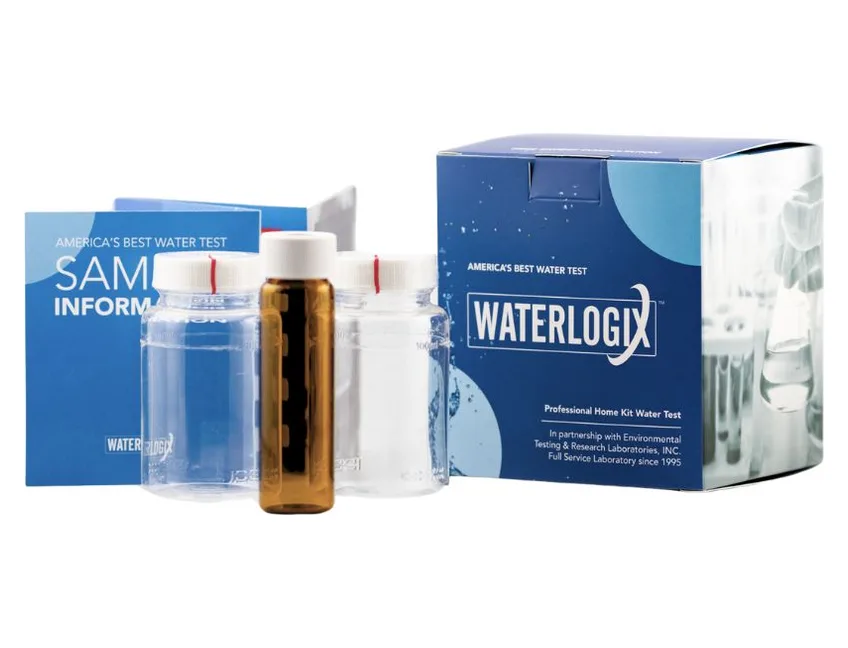
Waterlogix Advanced Well Water Test
US Water Systems (Waterlogix)
Manufacturer states: 56 well water contaminants by lab analysis, including coliform bacteria, nitrate, arsenic, lead and hardness, plus an on-site kit for iron-related and sulfate-reducing bacteria and hydrogen sulfide
- Analyzed by A lab the product page does not name · Manufacturer states: certified. The kit box says “in partnership with Environmental Testing & Research Laboratories, Inc.” We have not seen any certificate for this lab.
- Manufacturer states: Turnaround: 3–5 business days after the lab receives it
What it can't tell you: US Water Systems’ product page names no lab. Its kit box says “in partnership with Environmental Testing & Research Laboratories, Inc.”, and we have not seen any certificate for that lab or this test. US Water Systems says most customers get results and a treatment plan within about two weeks of ordering (one reviewer says about 2 weeks), and that plan comes from a company that sells treatment systems. It does not list PFAS. One sample shows one tap on one day.
Screening: quick check, not lab-grade

Watersafe Drinking Water Test Kit
Silver Lake Research
Lead, bacteria, nitrate, copper, iron, chlorine, hardness and pH
- Turnaround: Minutes; the bacteria test can take up to 48 hours
What it can't tell you: Each test gives a yes/no or a rough range, not a lab number, and it cannot detect PFAS or arsenic.
A mail-in kit’s lab is accredited (ISO/IEC 17025) but may not be certified by your state. For a home sale, a loan, or a health-department follow-up, use a state-certified lab.
Texas well water
Sources: CDC Well Water Index (2024) · USGS arsenic and nitrate models · USGS domestic well populations · EPA and CDC testing guidance. Data last updated 2026-11-09. All sources →
How many people use private wells in Texas?
About 1.7 million people across 254 Texas counties, by the USGS 2010 estimate. USGS models place about 107,200 of them in areas where wells are likely to be above the 10 µg/L arsenic limit. These are area estimates, not well results.
Are private wells regulated in Texas?
The quality and safety of drinking water from private domestic wells are not regulated by the Federal Government under the Safe Drinking Water Act nor by most state governments and laws. (EPA) Testing and treatment are the owner's responsibility.
Where can I get my well tested in Texas?
Texas Commission on Environmental Quality keeps the list of laboratories certified to test drinking water in Texas. Only use laboratories that are certified to do drinking water testing. (EPA)